Home › Guides › How to Clean Marble Countertops
CARE GUIDE
How to Clean Marble Countertops: What Toronto Homeowners Actually Need to Know
10 min read · Originally published 2020 · Last updated April 2026

Thomas Vibe Co-Founder at Stone Wizards
8+ years · 800+ countertops installed in GTA

Marble is the most beautiful and the most demanding countertop material in any kitchen. It delivers a look that no other surface can replicate, but it requires more careful daily attention than granite or quartz. Marble is softer, more porous, and chemically reactive to acids, which means the wrong cleaning product does not just damage a sealant. It damages the stone itself.
After 8+ years working with natural stone across Toronto and the GTA, including marble fabrication and installation, we see the same patterns: etching from acidic foods left on the surface, stains from delayed spill cleanup, and sealant neglect that leaves the stone unprotected. All preventable with the right habits.
This guide covers what works for daily marble care, how to handle stains and etching, what to avoid, and how to maintain the sealant that protects your investment. For care guides on other countertop materials, see our companion guides for cleaning quartz countertops and cleaning granite countertops.
KEY TAKEAWAYS
-
Daily marble cleaning requires only mild pH-neutral dish soap, warm water, and a soft cloth. The critical rule: blot spills immediately, never wipe (wiping spreads the liquid across more surface area)
-
Marble etches on contact with acidic substances (lemon, vinegar, tomato, wine). This is a chemical reaction with the calcium carbonate in the stone, not sealant damage, and it creates permanent dull spots that only professional honing can fully remove
-
Marble needs sealing more frequently than granite: every 6 to 12 months for kitchen countertops with regular use. The water droplet test is the most reliable way to check
-
Marble is softer than granite (3 to 4 on the Mohs scale vs 6 to 7 for granite), which means it scratches more easily. Never use abrasive pads, powders, or rough sponges
-
Accepting that marble develops patina over time is part of owning marble. The stone will change, and many homeowners find that the lived-in character adds to its beauty
Why marble needs more careful cleaning
Marble is metamorphic limestone, primarily composed of calcium carbonate. This composition gives marble its signature veining and translucent depth, but it also makes the stone chemically reactive and relatively soft compared to other countertop materials.
Three characteristics define how marble behaves in a kitchen: it is porous (absorbs liquids), it is soft (scratches more easily than granite or quartz), and it is acid-reactive (etches on contact with acidic substances). Understanding these three properties is all you need to care for marble properly.
This does not mean marble is fragile or a poor choice for kitchens. It means marble is a material that rewards attentive ownership. Kitchens across Italy, France, and the finest restaurants in Toronto have marble countertops that have served beautifully for decades. The difference is not the material. It is how the owner interacts with it daily.

Daily cleaning routine
Daily marble care follows the same basic principle as granite: protect the sealant, protect the stone. But marble adds one extra priority: protect the surface from acid contact.
Step 1. Blot any spills immediately. Do not wipe. Wiping spreads the liquid across more surface area, increasing the chance of staining or etching. Press a soft cloth or paper towel directly onto the spill to absorb it.
Step 2. Clean the surface with a soft cloth dampened with warm water and a few drops of mild, pH-neutral dish soap. Make sure the soap contains no citrus extracts, no vinegar, and no acidic ingredients.
Step 3. Rinse by wiping with a clean damp cloth to remove all soap residue. Soap buildup dulls marble's natural lustre faster than it dulls granite or quartz because marble's softer surface holds film more visibly.
Step 4. Dry thoroughly with a clean, soft cloth. Never let water sit on marble. Toronto's moderately hard municipal water leaves mineral deposits that are more visible on marble's polished surface than on darker stone.
Total time: under two minutes. The only habit that differs from granite care is Step 1 (blot, do not wipe). This single adjustment prevents the majority of marble staining issues.
The coaster and trivet rule
In a marble kitchen, coasters under glasses and trivets under cookware are not optional habits. They are protective measures. A wine glass ring, a lemon slice left on the counter, or a hot pan can each leave a permanent mark on marble that no cleaning product will remove. These are the kind of preventive details that separate marble owners who love their countertops from those who regret them.
How often to clean
After any food prep or cooking: immediately blot spills, then wipe down used areas with soap and water. Full surface wipe: once daily if the kitchen sees regular use. For marble bathroom vanities, a quick daily wipe after morning routines prevents product buildup from soaps, lotions, and toothpaste.
Understanding and managing etching
Etching is the single most important concept for any marble countertop owner to understand. It is different from staining, and the difference matters because the solution is completely different.
What etching is
When an acidic substance contacts marble, it chemically reacts with the calcium carbonate in the stone. This reaction dissolves a microscopic layer of the surface, leaving a dull, lighter-coloured spot on polished marble (or a darker spot on honed marble). This is etching.
The critical distinction: etching is not a stain sitting on top of the surface. It is physical damage to the stone itself. No cleaning product, no poultice, and no amount of scrubbing will remove an etch mark. Only professional honing and repolishing can fully restore an etched area.
What causes etching
Any acidic substance: lemon juice, lime, orange juice, vinegar, tomato sauce, wine (especially white wine and rosé, which are more acidic than red), salad dressing, mustard, ketchup, carbonated drinks, and many household cleaners. Even brief contact can leave a visible mark on polished marble.
How to minimise etching
Prevention is the only effective strategy:
-
Use cutting boards for all food preparation, especially acidic fruits and vegetables
-
Place coasters under all glasses, especially wine, juice, and carbonated drinks
-
Clean up acidic spills by blotting immediately (seconds matter, not minutes)
-
Never use acidic cleaners (vinegar, citrus-based, or any product with a pH below 7)
If etching does occur, a marble polishing powder (available at home improvement stores) can improve light etch marks on polished marble. Apply according to product directions, buff with a soft cloth, and reseal the treated area. For deeper etching, professional honing is the only reliable solution.
Accepting patina as part of marble ownership
Here is an honest perspective that most marble care guides avoid: if you use marble as a kitchen countertop, it will develop patina over time. Small etch marks, minor scratches, and subtle colour changes are part of how marble ages. Many homeowners, particularly those who chose marble specifically for its natural character, find that this lived-in quality adds warmth and authenticity to the stone.
If the idea of a surface that changes over time bothers you, marble may not be the right choice for a busy kitchen. For a comparison of how different materials handle daily kitchen life, see our granite vs quartz countertops guide.
Removing stains from marble
Marble stains (as opposed to etch marks) are caused by liquids that have soaked into the porous stone and discoloured it from within. The approach is similar to granite stain removal: a poultice draws the stain out of the stone over time.
Oil-based stains
Cooking oil, butter, grease, and cosmetics leave dark spots where the oil has soaked into the marble. Mix baking soda with water to form a thick paste, spread over the stain approximately 5mm thick, cover with cling film, tape down edges, and leave for 24 to 48 hours. The baking soda draws the oil out as it dries. Rinse, dry, and repeat if needed.
Organic stains (coffee, tea, wine, fruit)
These leave brownish or pinkish discolouration. Use the same baking soda poultice, but mix with hydrogen peroxide instead of water for better results on organic stains.
Important: Use hydrogen peroxide only on white or light-coloured marble. On darker marble varieties, peroxide can lighten the stone's natural colour.
Hard water deposits
White crusty mineral buildup, common in Toronto kitchens due to GTA water hardness. A baking soda paste (3:1 baking soda to water) applied with a soft sponge and left for 5 minutes handles most deposits. Do not use vinegar or citrus to dissolve mineral deposits on marble. This will etch the surface and create a worse problem than the water stain.
What NOT to use on marble
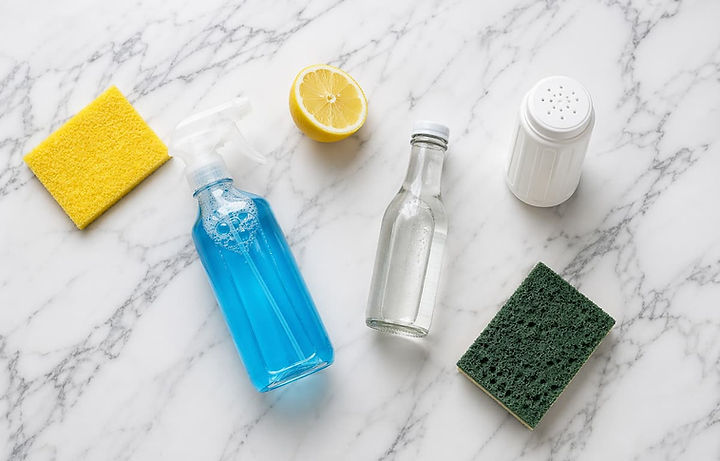
Marble is more sensitive to cleaning products than granite or quartz. Products that are safe for granite may damage marble. This is because marble is both softer and chemically reactive.
Any acidic cleaner (vinegar, lemon, citrus)
This is the most critical rule for marble. Acidic cleaners do not just damage the sealant (as with granite). They chemically react with the marble itself, causing permanent etching. Even "natural" cleaners marketed as gentle (vinegar and water solutions, lemon-based sprays) will etch marble on contact. There is no safe concentration of vinegar for marble cleaning.
Ammonia and ammonia-based glass cleaners
Ammonia is alkaline, not acidic, so it does not etch marble. However, it degrades the sealant with repeated use and can dull the polished surface over time. Avoid for daily cleaning.
Bleach and harsh disinfectants
Bleach can discolour marble, particularly lighter varieties. For disinfecting, use isopropyl alcohol (70%, undiluted) sprayed on the surface, left for 3 to 5 minutes, then wiped clean with a soft cloth. This sanitises without affecting the stone or sealant.
Abrasive pads, powders, and rough sponges
Marble is softer than granite (3 to 4 on the Mohs scale compared to 6 to 7 for granite). Abrasive materials scratch marble much more easily. Use only soft cloths, microfibre towels, or very soft non-abrasive sponges. Even the rough side of a standard kitchen sponge can scratch polished marble.
The simple rule for marble
If the product is acidic, it will etch. If the product is abrasive, it will scratch. If the product is harsh, it will damage the sealant. For daily cleaning, mild pH-neutral dish soap and warm water is the only product you need.
Sealing your marble countertop
Marble requires more frequent sealing than granite because it is more porous. A well-maintained sealant is your primary defence against staining (though it does not prevent etching, which is a chemical reaction with the stone itself).
When to reseal
Every 6 to 12 months for marble kitchen countertops with regular daily use. Marble bathroom vanities with lighter use may go up to 12 months between reseals. Use the same water droplet test as granite: sprinkle water on the surface, wait 10 to 15 minutes. If the water absorbs (darkens the stone), reseal.
How to reseal (same process as granite)
Clean the entire surface with isopropyl alcohol and water (50/50) to remove all soap residue. Dry completely. Apply a penetrating stone sealer according to product directions, let absorb for the recommended time, wipe away excess, and allow to cure for 24 hours before full use.
One important difference from granite: marble sealers should be specifically formulated for marble or calcium-based stone. Some granite sealers contain ingredients that may react with marble. Check the label to confirm compatibility with marble before applying.
When to call a professional
Most daily marble care is manageable at home. Professional help is warranted in these specific situations:
Deep etching that marble polishing powder cannot fix. If acidic substances sat on the marble long enough to create deep etch marks that consumer-grade polishing powder cannot improve, professional honing and repolishing is needed. This involves progressively finer diamond abrasives to restore the polished surface. It is precision work that requires experience with marble specifically.
Deep stains that the poultice method cannot remove. Professional stone restoration specialists have access to commercial-grade poultice compounds and techniques that go beyond household methods. If two rounds of DIY poultice treatment have not improved the stain, professional assessment is the next step.
Cracks or chips from impact. Marble is softer than granite and more susceptible to chipping at edges and corners. Professional repair uses colour-matched epoxy and precision grinding to restore the damaged area. This is fabrication work, not cleaning.
Full surface restoration. If the marble has years of accumulated etch marks, dull patches, and surface wear, professional diamond polishing can restore it to near-original condition. This is particularly worthwhile for high-quality marble installations where the stone itself is valuable and replacement would be significantly more expensive than restoration.
If the damage is extensive enough that restoration costs approach replacement costs, it may be worth exploring new countertop options. Visit our showroom to discuss whether restoration or replacement makes more sense for your situation. We work with marble, granite, quartz, and porcelain, so our recommendation is based on your needs, not on pushing one material.
Frequently Asked Questions
"Written by Thomas Vibe, Co-Founder of Stone Wizards. 8+ years and 800+ countertops installed across Toronto and the GTA. Featured in Realtor.com, Business Insider, Men's Health."
CONTINUE READING
Keep exploring countertop guides.
Three more articles to help you make the right choice for your kitchen.

PRICING GUIDE
Complete breakdown of quartz pricing in the GTA. What you'll pay per square foot and why.
12 min read
→
HOW-TO GUIDE
Care, maintenance, and the right way to restore shine to your quartz surfaces.
12 min read
→

BRAND REVIEW
Caesarstone, Silestone, HanStone, Cambria, MSI. Which brand is right for you?
13 min read
→