Home › Guides › How to Clean Quartz Countertops
CARE GUIDE
How to Clean Quartz Countertops: What Actually Works (and What Causes Damage)
9 min read · Originally published 2020 · Last updated April 2026

Thomas Vibe Co-Founder at Stone Wizards
8+ years · 800+ countertops installed in GTA

Quartz countertops are the easiest kitchen surface to keep clean. That is not marketing. It is the practical reality we see across 800+ installations in Toronto and the GTA. But "easy" does not mean "anything goes." Some common cleaning habits and products that seem harmless can gradually damage the resin that holds quartz together, and the damage only becomes visible months later when it is too late to reverse.
This guide covers what actually works for daily cleaning, how to handle stubborn stains, and what to keep away from your quartz surface. If your countertop has already lost its shine or developed dull spots, our companion guide covers how to polish and restore quartz countertops.
KEY TAKEAWAYS
-
Daily quartz cleaning requires nothing more than mild dish soap, warm water, and a soft cloth. No special products, no sealing, no scheduled maintenance
-
The most common cleaning mistake we see in Toronto kitchens is using ammonia-based or acidic cleaners that gradually damage the polymer resin binding the quartz
-
Quartz is non-porous (approximately 93 percent ground quartz and 7 percent polymer resin), which means stains sit on the surface rather than absorbing into the material
-
Stubborn stains like dried food, ink, or adhesive residue respond well to isopropyl alcohol applied with a soft cloth
-
Professional cleaning is rarely needed for quartz. In 800+ installations, the cases that required professional intervention almost always involved chemical damage from the wrong cleaning products, not normal use
Why quartz is the easiest countertop to clean
The cleaning simplicity of quartz comes from one characteristic: it is non-porous. The polymer resin that binds the ground quartz particles together creates a surface with no microscopic openings for liquids, bacteria, or stains to penetrate.
This is fundamentally different from natural stone. Granite has natural pores that absorb liquids unless sealed annually. Marble is even more porous and etches on contact with acidic substances. Quartz does neither. When coffee spills on quartz, it sits on the surface waiting for you to wipe it up, whether that is thirty seconds later or three hours later.
In practical terms, this means:
-
No sealing. Ever. Not annually, not once, not at installation. The factory finish is the permanent finish.
-
No special cleaning products required. The same dish soap you use for your plates cleans your countertop.
-
No bacteria concerns. Non-porous means mold, mildew, and bacteria have no surface to colonize. A basic wipe sanitizes the surface.
This is one of the key reasons over 95 percent of our Toronto clients choose quartz over other countertop materials. The daily reality of living with quartz is genuinely simpler than any alternative.

Daily cleaning: the only routine you need
This is the entire daily cleaning process for quartz countertops:
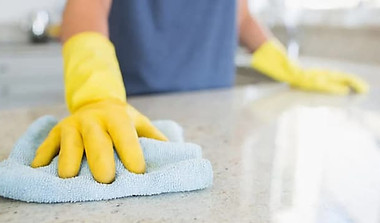
Step 1. Wipe the surface with a soft cloth or microfiber dampened with warm water and a few drops of mild dish soap.
Step 2. Rinse by wiping again with a clean damp cloth (no soap).
Step 3. Dry with a clean, dry cloth or paper towel.
That is it. The whole process takes under a minute for a standard kitchen countertop. No special products, no buffing, no treatment.
Why drying matters more than most people think
The step most homeowners skip is drying. In Toronto and the GTA, municipal water is moderately hard (contains dissolved calcium and magnesium minerals). When water evaporates on your quartz surface, those minerals are left behind as white spots or a cloudy film. This is not damage to the quartz. It is mineral residue sitting on the surface. But over weeks, the buildup becomes visible and makes the countertop look dull.
Drying after each wipe prevents this entirely. If you already have hard water buildup, a paste of baking soda and water (3:1 ratio) applied gently with a soft sponge removes it without risk to the surface.
How often to clean
After cooking or food prep: always wipe down the areas you used. This prevents food residue from drying and becoming harder to remove later.
Full surface wipe: once a day if the kitchen is used daily, which covers most Toronto households. If you had a light day in the kitchen, a quick wipe with just water is enough.
Once or twice a year, you can do a full surface cleaning with a pH-neutral stone cleaner for extra freshness. This is optional maintenance, not required care. Your quartz will perform identically without it.
Removing stubborn stains and marks
Normal daily cleaning handles 95 percent of what your quartz countertop encounters. For the other 5 percent, here is what works.
Dried food and cooking residue
Dried sauces, cheese, dough, or other food that has hardened on the surface: do not scrub with abrasive pads. Instead, lay a warm, damp cloth over the area for 3 to 5 minutes to soften the residue. Then wipe away with gentle pressure. If the residue is particularly stubborn, a plastic scraper (not metal) can help lift it without scratching.
Grease and oil films
Cooking oil, butter, and grease leave a film that soap and water alone sometimes do not fully cut. Mix equal parts isopropyl alcohol (rubbing alcohol) and water in a spray bottle. Spray the greasy area, let it sit for one minute, then wipe with a soft cloth and rinse. This is one of the most effective quartz-safe degreasers, and it is likely already in your medicine cabinet.
Ink, marker, and dye stains
These are among the few substances that can be challenging on quartz because the pigments can bond to the resin surface if left for extended periods. Apply a small amount of isopropyl alcohol to a soft cloth and gently work the stain. Do not pour alcohol directly on the countertop in large amounts. For dried ink or permanent marker, patience and multiple gentle applications work better than aggressive scrubbing.
Hard water spots and mineral deposits
Common in Toronto due to GTA water hardness. As described above, a baking soda paste (3 parts baking soda to 1 part water) applied with a soft sponge, left for 5 minutes, then rinsed and dried, handles most mineral buildup. For heavier deposits, repeat the process rather than increasing pressure.
The one stain type that genuinely challenges quartz
In our installation experience, the stains we see that are genuinely difficult to remove from quartz are chemical stains: damage caused by bleach, oven cleaner, drain cleaner, or other harsh chemicals that were left on the surface. These substances attack the resin itself, not just the surface layer. If the discolouration is from chemical damage rather than a surface stain, no cleaning method will fully restore it because the resin structure has been altered.
This is why what you avoid putting on your quartz matters more than what you use to clean it.
What NOT to use on quartz

This section matters more than the cleaning tips above. Using the wrong product once probably will not cause visible damage. Using it weekly for six months will, and by the time you notice, the damage is permanent.
Ammonia-based cleaners
This includes many glass cleaners and multi-surface sprays. Ammonia gradually breaks down the polymer resin that binds the quartz particles together. The result is a slow dulling of the surface that homeowners often mistake for natural wear. It is not wear. It is chemical degradation that proper cleaning would have prevented.
We mention this specifically because some online guides recommend glass cleaners for quartz. Some manufacturers also give contradictory guidance on this. Our position after 800+ installations: avoid ammonia-based cleaners entirely. Dish soap and water deliver the same cleaning result without the long-term risk.
Acidic cleaners (vinegar, lemon, citrus-based products)
This is another area where online advice conflicts. Some guides recommend vinegar and water solutions for quartz cleaning. While diluted vinegar may not cause immediate visible damage, acidic substances interact with the resin over time, especially with repeated use.
Our recommendation: use pH-neutral cleaners only. If you want something stronger than dish soap, choose a cleaner specifically labeled safe for engineered quartz. There is no cleaning situation on quartz that requires an acidic cleaner, so there is no reason to take the risk.
Bleach and oxidizing cleaners
Bleach, hydrogen peroxide-based cleaners, oven cleaners, and drain cleaners can cause permanent discolouration on quartz. Even brief contact can leave visible marks on darker quartz colours. If any of these substances accidentally contacts your countertop, rinse immediately and thoroughly with plenty of water.
Abrasive pads and powders
Steel wool, rough scouring pads, and powdered abrasive cleaners (like traditional scouring powder) can scratch the polished surface of quartz. The scratches may be microscopic initially but accumulate over time into visible dullness. Use only soft cloths, microfiber towels, or non-abrasive sponges.
The simple rule
If a product is not something you would use on your skin, do not use it on your quartz countertop. Mild, gentle, pH-neutral. That is the entire cleaning philosophy.
When to call a professional
In most cases, quartz countertop maintenance is entirely DIY. Professional cleaning or restoration is a rare need, not a regular service. After 800+ installations across Toronto, here are the situations where professional help is genuinely warranted:
Chemical damage that has altered the surface. If a harsh cleaner has caused discolouration or dull patches that do not respond to gentle cleaning, the resin may be damaged. A professional stone restoration specialist can sometimes improve the appearance through specialised techniques, but full reversal is not always possible.
Deep scratches or chips. Normal kitchen use rarely causes these, but heavy impacts (dropped cast iron, ceramic dish edges) can. Professional repair uses colour-matched resin and precision buffing to restore the surface. This is not a cleaning issue but a fabrication repair.
Burn marks from sustained heat exposure. If a hot pan was left on the surface long enough to discolour the resin, professional assessment determines whether the damage is surface-level (repairable) or structural (requires section replacement).
For a detailed guide on restoration techniques and what professional quartz restoration costs in Toronto, see our guide to polishing quartz countertops.
If the damage is extensive enough that restoration costs approach replacement costs, it may be worth exploring new quartz countertop options for your Toronto kitchen.
Frequently Asked Questions
"Written by Thomas Vibe, Co-Founder of Stone Wizards. 8+ years and 800+ countertops installed across Toronto and the GTA. Featured in Realtor.com, Business Insider, Men's Health."
CONTINUE READING
Keep exploring countertop guides.
Three more articles to help you make the right choice for your kitchen.