Home › Guides › Pros and Cons of Quartz
BUYER'S GUIDE
Pros and Cons of Quartz Countertops: What Toronto Homeowners Actually Need to Know
10 min read · Originally published 2020 · Last updated April 2026

Thomas Vibe Co-Founder at Stone Wizards
8+ years · 800+ countertops installed in GTA

Quartz is the most popular countertop material in Toronto right now, and for good reason. But popular does not mean perfect. After 8+ years fabricating and installing over 800 quartz countertops across Toronto and the GTA, we have seen what quartz does well and where it genuinely falls short. This guide covers both sides honestly so you can decide whether quartz fits your kitchen, your lifestyle, and your budget.
KEY TAKEAWAYS
-
Quartz countertops are non-porous, meaning zero sealing, zero special maintenance, and strong resistance to stains and bacteria, which is why over 95 percent of our Toronto clients choose quartz today
-
The most common real-world limitations are heat sensitivity (trivets required) and unsuitability for outdoor kitchens due to UV exposure
-
All major quartz brands use similar chemistry (approximately 93 percent ground quartz and 7 percent polymer resin), so quality differences between brands come from pattern design, not raw durability
-
Direct-from-manufacturer options like Stone Wizards Select start at $45 per square foot installed, which puts quartz within reach of most kitchen renovation budgets
-
For most Toronto kitchens, quartz offers the best balance of durability, design variety, and low maintenance of any countertop material currently available
What quartz countertops actually are?
Quartz countertops are engineered stone, not mined natural stone. They are made by combining approximately 93 percent ground natural quartz with 7 percent polymer resins and pigments. The mixture is pressed into slabs under high pressure, cured, and polished.
The result is a surface that looks like natural stone but performs differently in important ways. Unlike granite or marble, quartz is completely non-porous. Nothing absorbs into it. That single characteristic drives most of the pros, and the resin component drives most of the cons.
The major quartz brands you will encounter in Toronto (Caesarstone, Silestone, HanStone, Cambria, MSI) all use variations of this same basic process. For a detailed comparison of how these brands differ, see our best quartz countertop brands comparison.
The real pros of quartz countertops
These are not marketing claims. They are observations from over 800 installations across Toronto kitchens of every size, style, and budget level.

Zero maintenance, no sealing, ever
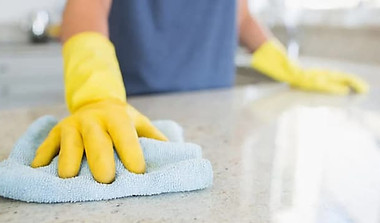
This is the single biggest reason our Toronto clients choose quartz. Granite requires annual sealing to maintain stain resistance. Marble needs even more attention. Quartz needs nothing beyond soap, water, and a cloth.
In practical terms, this means you never think about your countertop maintenance schedule. You do not buy sealing products. You do not worry about whether last year's sealant has worn off while wine is sitting on the surface. For busy Toronto families, this translates to genuine daily convenience that compounds over years of ownership.
For the right way to keep quartz looking its best with minimal effort, see our guide to polishing quartz countertops.
Stain and bacteria resistant
Because quartz is non-porous, liquids sit on the surface rather than absorbing into it. Coffee, wine, oil, tomato sauce, and every other kitchen substance wipes away cleanly. This also means bacteria, mold, and mildew have no pores to colonize, making quartz one of the most hygienic countertop surfaces available.
In 800+ installations, the staining issues we have seen on quartz are almost exclusively from leaving strong chemicals (bleach, oven cleaner, drain cleaner) sitting on the surface for extended periods. Normal kitchen use, even aggressive cooking, does not stain quartz.
Massive design selection
Quartz offers more design variety than any natural stone. Hundreds of patterns are available across major brands, from realistic marble looks and warm earth tones to bold modern concrete textures and solid colours. Because quartz is engineered, manufacturers can create patterns that natural stone simply cannot produce.
This matters practically because you can match your countertop precisely to your cabinetry, backsplash, and flooring without being limited to whatever nature quarried that season.
Consistent appearance
With natural stone, the slab you see in the showroom may look different from the slab that arrives for installation. Colour variation, veining shifts, and natural inconsistencies are part of the material. With quartz, what you approve in the showroom is what gets installed in your kitchen. No surprises.
For homeowners who are planning their entire kitchen design around a specific countertop appearance, this predictability is a significant advantage.
Durability for busy kitchens
Quartz rates 7 on the Mohs hardness scale and resists scratching from knives, everyday kitchen tools, and typical household use. It does not chip or crack under normal conditions. The resin component actually gives quartz slight flexibility compared to natural stone, which means it absorbs minor impacts rather than fracturing.
In our Toronto installations, the durability issues we encounter with quartz are rare and almost always involve extreme force (dropping a heavy cast iron pan directly on an edge) rather than normal kitchen use.
Strong resale value in Toronto market
Quartz has become the expected standard in modern Toronto kitchens, particularly in condos and contemporary renovations. Real estate agents consistently identify quartz countertops as a feature that helps homes sell faster. In the GTA market, "quartz countertops" in a listing signals a modern, updated kitchen, which is one of the top buyer priorities.
This does not mean granite lacks resale value. Granite still holds strong in traditional and luxury homes. But for the majority of Toronto properties being renovated today, quartz is what buyers expect to see.
The real cons of quartz countertops
Every material has limitations. Here is where quartz genuinely falls short, and what those limitations mean in practical terms.
Heat sensitivity
This is the most important con to understand. Quartz handles normal kitchen temperatures without issue, but the polymer resin in its composition can be damaged by sustained direct heat. Placing a hot pan straight from the stove or oven onto a quartz surface can cause discolouration or, in extreme cases, cracking.

The practical reality: In 800+ installations, the heat damage cases we have seen almost always involved leaving a hot pan on the surface for an extended period, not brief contact. Using trivets or hot pads eliminates this risk entirely. If you are the kind of cook who always grabs a trivet before setting down a hot pan, this con is a non-issue. If you regularly place pots directly from the stove onto the counter without thinking, granite may be a better fit for your cooking style.
Not suitable for outdoor kitchens
UV exposure causes quartz colours to fade and the resin to deteriorate over time. Quartz is designed for indoor use only. If you are building an outdoor kitchen, granite or natural stone is the right choice.
This limitation affects a small percentage of Toronto homeowners (outdoor kitchens are relatively uncommon in the GTA climate), but it is worth knowing if outdoor entertaining is part of your renovation plan.
Higher upfront cost than laminate
Quartz is more expensive than laminate countertops. Laminate starts significantly lower per square foot, making it the go-to for ultra-budget renovations. If your total countertop budget is under $1,000, laminate may be your only realistic option.
The practical context: Quartz has become more accessible than many homeowners expect. Direct-from-manufacturer options like Stone Wizards Select start at $45 per square foot installed, which puts quartz within reach for most kitchen renovation budgets. For a complete breakdown of what drives quartz pricing in Toronto, see our quartz countertops cost guide.
Professional installation required
Quartz slabs are heavy (a standard 3cm slab weighs roughly 20 pounds per square foot) and require precision cutting, polishing, and leveling. This is not a DIY-friendly material. Professional fabrication and installation are mandatory.
Why this is actually an advantage: Professional installation means your countertop is templated precisely to your kitchen, cut on CNC equipment, and installed by experienced fabricators who handle seaming, leveling, and edge finishing. DIY countertop installations, even with lighter materials, frequently result in uneven surfaces, poor seam quality, and fitting issues that cost more to fix than professional installation would have cost in the first place.
Less natural character than granite or marble
If you want a countertop with the unique, organic variation that comes from millions of years of geological formation, quartz will not deliver that. Each quartz slab of the same pattern looks essentially identical. Some homeowners find this too uniform or "manufactured" looking.
2026 context: Premium quartz patterns from brands like Cambria and top-tier Caesarstone collections have become remarkably close to natural stone in appearance. At arm's length, many marble-look quartz patterns are nearly indistinguishable from real marble. The gap between quartz and natural stone in terms of visual realism is smaller in 2026 than it has ever been.
Visible seams on large projects
Quartz slabs come in standard sizes (typically around 120 by 63 inches). Kitchens with long runs of countertop or large islands will require multiple slabs, which means visible seams. While seams in quartz can be made tighter than in natural stone, they are still present.
How experienced fabricators handle this: Seam placement matters more than seam quality. An experienced fabricator positions seams in low-visibility locations (behind the sink, at an inside corner, at the end of an island run) and matches slab patterns across the seam. In most of our Toronto installations, clients forget where their seams are within weeks of living with the kitchen.
When quartz is not the right choice
Quartz is the right material for most Toronto kitchen renovations. But "most" is not "all". Here are the situations where a different material genuinely fits better.
You are building an outdoor kitchen. Quartz resin deteriorates under UV exposure. Outdoor countertops need granite, concrete, or porcelain. This is not a preference, it is a material limitation with no workaround.
You cook at very high heat and never use trivets. If placing hot pots and pans directly on the counter is non-negotiable for your cooking style, granite handles direct heat that quartz cannot. Most cooks adapt to trivets quickly, but if this is a firm priority, granite is the honest recommendation. For a full comparison of how these two materials differ, see our granite vs quartz countertops guide.
You want the unique character of natural stone and nothing else will do. No engineered material, regardless of how realistic the pattern, fully replicates the geological depth and one-of-a-kind variation of real granite or marble. If you want a countertop where every vein formed over millions of years and no two slabs on earth are alike, natural stone is what you are looking for.
Your total countertop budget is under $1,000. At this budget level, laminate or solid surface is the practical option. Quartz starts at $45 per square foot installed through our entry-level tier, which means a standard 30-square-foot kitchen starts around $1,350. If your budget cannot reach that range, quartz is not the right fit right now.
You need countertops for a temporary or very short-term situation. If you are renovating a property you plan to sell within months, or need a quick functional surface before a larger renovation, laminate delivers adequate performance at a fraction of the cost. Quartz is a long-term investment that makes most sense when you will live with it for years.
For most Toronto homeowners reading this guide, none of these exceptions apply. If your kitchen is indoors, you are comfortable using trivets, and your budget can accommodate entry-level quartz pricing, quartz will likely serve your kitchen better than any alternative.
Getting more from your countertop budget

One of the most common reasons homeowners hesitate on quartz is the assumption that it requires a premium budget. That was more true five years ago than it is today.
How direct-from-manufacturer sourcing changes the equation
The price difference between quartz tiers comes primarily from brand marketing and retail distribution costs, not from material quality. All major quartz brands use comparable chemistry (93 percent quartz, 7 percent resin). What changes the price is how much brand infrastructure is built into each square foot.
Stone Wizards Select is our direct-from-manufacturer sourcing, where we work with certified manufacturers that focus on the fabricator B2B market rather than consumer retail. The result is mid-tier quality quartz starting at our entry-level installed pricing, which includes slab material, CNC fabrication, standard edge, sink cutout, delivery, installation, and seaming.
This means a standard 30 to 40 square foot Toronto kitchen can have quartz countertops installed for significantly less than most homeowners expect when they first start researching.
When to invest in branded quartz instead
Direct-from-manufacturer sourcing is not always the right answer. If you want a specific marble-look pattern with dimensional veining (Cambria Brittanicca, Caesarstone Calacatta Nuvo), brand-name recognition for luxury resale, or the widest possible colour catalog, branded quartz delivers those things. The premium you pay reflects design sophistication and brand infrastructure, both of which have real value for certain projects.
The choice is not "good versus bad." It is "which cost structure matches your priorities." We install both at Stone Wizards, and we help you decide during a showroom consultation.
For a detailed breakdown of quartz pricing in Toronto including tier comparisons and what is included in a standard quote, see our quartz countertops cost guide.
Budget allocation tip
If you are doing a full kitchen renovation, countertops typically represent 8 to 15 percent of the total budget. Choosing entry-level quartz through direct-from-manufacturer sourcing lets you deliver quartz durability and appearance while reallocating the savings toward cabinetry, appliances, or backsplash, wherever your priorities are highest.
If you are exploring quartz countertops in Toronto, visiting a showroom to see both branded and direct-from-manufacturer options side-by-side is the fastest way to understand how the tiers compare in person.
Frequently Asked Questions
"Written by Thomas Vibe, Co-Founder of Stone Wizards. 8+ years and 800+ countertops installed across Toronto and the GTA. Featured in Realtor.com, Business Insider, Men's Health."
CONTINUE READING
Keep exploring countertop guides.
Three more articles to help you make the right choice for your kitchen.

PRICING GUIDE
Complete breakdown of quartz pricing in the GTA. What you'll pay per square foot and why.
12 min read
→
HOW-TO GUIDE
Care, maintenance, and the right way to restore shine to your quartz surfaces.
12 min read
→

BRAND REVIEW
Caesarstone, Silestone, HanStone, Cambria, MSI. Which brand is right for you?
13 min read
→